NDAs for Remote Developers: What to Include and What to Skip
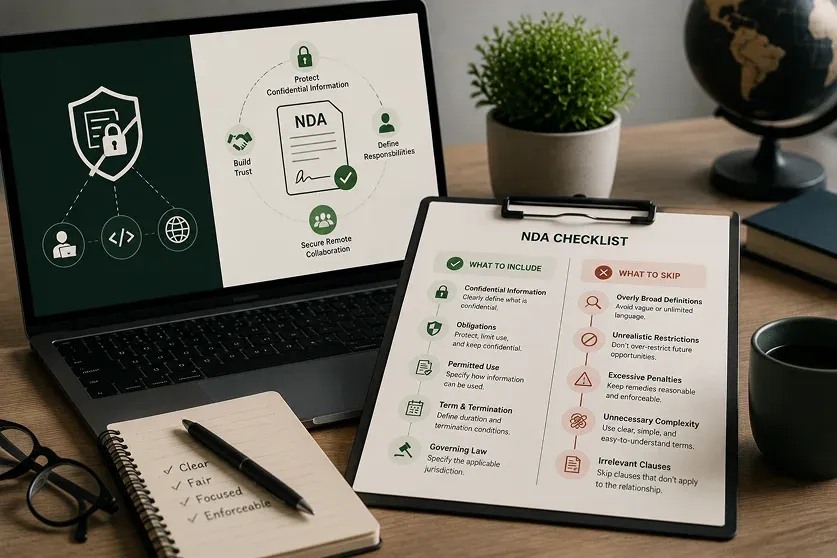
An NDA is not optional when hiring remote developers. It is the crucial document that determines whether your source code, product roadmap, and business logic stay protected if the relationship goes wrong. Most companies sign generic templates and assume the rest is covered. It is not

“Furqan Aziz is CEO & Founder of InvoZone. He is a tech enthusiast by heart with 10+ years ...” See more
Don’t Have Time To Read Now? Download It For Later.
Table of Contents
- First, What an NDA Actually Does
- The Three Types of NDAs (And What Most Founders Get Wrong)
- What to Include: The Core Clauses
- 1. A Clear, Specific Definition of Confidential Information
- 2. The Purpose of Disclosure
- 3. Reverse Engineering Prohibition
- 4. Standard Exclusions
- 5. The Duration of Confidentiality
- 6. Jurisdiction, Governing Law, and Remedies
- 7. Data Protection and Security Obligations
- 8. Return and Deletion of Materials
- 9. IP Assignment Clause
- 10. Residuals Carve-Out Use with Caution
- The Mistakes That Leave Your IP Exposed
- How InvoZone Handles This for You
- A Final Thought
First, What an NDA Actually Does
Before we get into what to include, let us be clear about what an NDA is and what it is not.
A Non-Disclosure Agreement is a legal contract that prohibits a developer from sharing confidential information with unauthorized third parties. It sets boundaries around what information is protected, how it can be used, and what happens if someone breaks the agreement.
|
What an NDA Does |
What an NDA Does NOT Do |
|
Prevents developers from sharing trade secrets, source code, or strategies. |
Does not automatically transfer IP ownership (you need a separate IP assignment clause). |
|
Gives you legal recourse and grounds for damages if a breach occurs. |
Does not prevent them from working for competitors (non-competes are rarely enforceable). |
|
Establishes a clear, formal baseline of professional confidentiality. |
Does not guarantee easy cross-border enforcement without specific jurisdiction clauses. |
The Three Types of NDAs (And What Most Founders Get Wrong)
Many founders treat NDAs as one-size-fits-all.
Think of it like vehicles: a sedan, a pickup truck, and a school bus will all get you from point A to point B. You wouldn't use a sedan to move a three-piece sectional couch, and you wouldn't use a pickup truck to transport fifty people. Right? So yes, the vehicle matters. Similarly the NDA type matters just as much.
Unilateral NDA (One-Way)
How it works
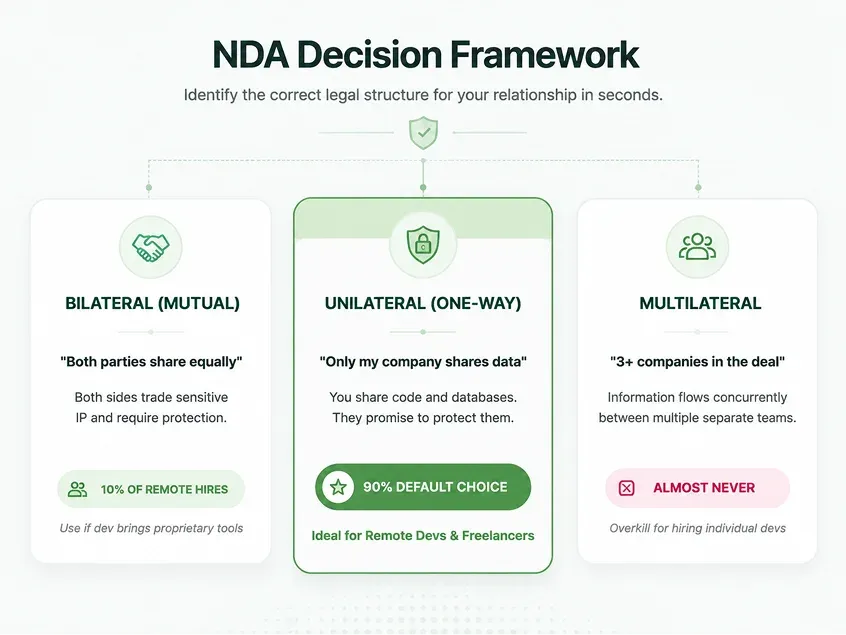
You hand over your proprietary code, designs, and databases to a developer, and they promise not to share them.
When to use it
This is your default starting point for 90% of remote developer, freelancer, and employee hires.
Why to skip for developers
Skip this and use a Bilateral (Mutual) NDA instead if you are hiring a highly specialized senior developer or agency who insists on using their own pre-existing, proprietary code frameworks or tools to build your project.
Bilateral NDA (Two-Way/Mutual)
In a mutual agreement, both parties are sharing secrets, and both sides agree to keep everything confidential.
How it works
Both sides are actively disclosing sensitive information to see if their technologies can integrate.
When to use it
Use this for B2B partnerships, joint ventures, or mergers.
Why to skip for developers
Unless you are hiring an agency that brings its own highly proprietary software development kits (SDKs) to the table, a mutual NDA is overkill.
Multilateral NDA (Multi-Party)
This is a complex agreement involving three or more separate companies where everyone agrees to protect shared information.
How it works
Instead of signing separate mutual agreements between every single party, one contract covers everyone.
When to use it
Complex multi-company collaborations (e.g., your startup, a separate design agency, and an external security firm working on the same project).
Why to skip for developers
It is completely unnecessary for individual hires. Using a multilateral NDA for a developer is like driving a commercial bus to the grocery store.
Which One Do You Actually Need?
Here is a simple decision framework.
What to Include: The Core Clauses
1. A Clear, Specific Definition of Confidential Information
This is the most important part of your NDA.
A vague definition like "any and all business-related information" is useless. It is too broad to be enforceable and too unclear for the developer to know what they are actually protecting.
Instead, be specific.
List exactly what counts as confidential. For remote developers, this typically includes:
- Source code, algorithms, and software architecture
- Product designs, specifications, and roadmaps
- Business strategies, pricing, and customer lists
- Proprietary data, trade secrets, and technical know-how
- System architecture and security protocols
- Testing strategies and quality assurance methods
If you want broader coverage, include a clause that says any information marked as "confidential" at the time of disclosure is also covered.
Pro Tip
Do not call everything confidential. Overreach makes the agreement harder to enforce and less credible.
2. The Purpose of Disclosure
Your NDA should state why you are sharing confidential information with the developer. This gives context and prevents the developer from claiming they did not know what the information was for.
For remote developers, this might be "for the purpose of developing the [Product Name] software" or "for the purpose of providing software development services."
3. Reverse Engineering Prohibition
This clause bars the developer from decompiling, disassembling, or otherwise reverse-engineering any software they access. This is non-negotiable when you are sharing compiled binaries, SDKs, or proprietary libraries with a third party.
4. Standard Exclusions
Every good NDA includes exclusions which are the things that are not considered confidential. These protect the developer from being held responsible for things they cannot control.
Include exclusions for:
- Information that is already in the public domain
- Information the developer already knew before signing the agreement
- Information independently developed by the developer without using your confidential information
Many NDAs skip these exclusions, which can make the agreement unfair or unenforceable. A balanced agreement protects both parties and builds a stronger partnership.
5. The Duration of Confidentiality
Your NDA needs to specify how long the confidentiality obligations last.
A typical NDA lasts between 1 and 5 years. Anything beyond that could be challenged in court. The obligation should also extend beyond the termination of the working relationship.
For remote developers, consider a duration that aligns with the shelf life of your competitive advantage. If your product evolves quickly, a shorter term may be sufficient. If you are protecting long-term trade secrets, a longer term makes sense.
Common mistake: Setting unrealistic terms like "forever" often leads to legal complications.
6. Jurisdiction, Governing Law, and Remedies
This is where most NDAs for remote developers fall apart. If your developer lives in a different country, you need to specify which country's laws govern the agreement and which courts have jurisdiction.
What to include:
- A clear governing law clause (e.g., "This agreement shall be governed by the laws of [Your State/Country]")
- A jurisdiction clause stating where disputes will be resolved
- A dispute resolution mechanism, such as arbitration
You should also spell out what happens if the developer breaks the NDA. Include:
- The right to seek an injunction to stop further disclosure
- The right to claim damages for losses caused by the breach
- The right to recover legal costs
Without these clauses, your NDA is just a piece of paper. With them, you have actual recourse if something goes wrong.
7. Data Protection and Security Obligations
Remote developers handle your data outside your physical control. Your NDA should address this directly.
Include clauses that require the developer to:
- Adhere to specific security measures
- Promptly report any security breaches
- Comply with relevant data privacy regulations like GDPR, HIPAA, or India's DPDP provisions
- Use encryption and secure access protocols
This is increasingly important as data privacy regulations become stricter worldwide. If the developer handles personal data, you may also need a separate Data Processing Agreement (DPA).
8. Return and Deletion of Materials
This is the part that most templates overlook. When the engagement ends, what happens to the code, files, and data stored on the developer's devices?
Spell it out:
- All confidential materials must be returned
- All copies must be deleted from personal devices and cloud storage
- Certification of deletion should be provided
9. IP Assignment Clause
This is the clause that founders usually forget.
An NDA tells people what they cannot disclose. An IP assignment clause handles who owns the code.
This clause should explicitly state:
- That all work and code created by the developer are the exclusive property of your company
- That the developer assigns all rights, title, and interest in deliverables to you
- That the assignment happens upon creation or upon payment
A well-drafted IP assignment clause ensures that all IP rights created by developers are transferred to you. Without it, the developer could potentially claim ownership of the code they wrote for you.
10. Residuals Carve-Out Use with Caution
A residuals clause lets the receiving party use information retained in unaided memory after the engagement ends. Many large technology vendors insist on it.
For most founders hiring remote developers, you should resist this clause or narrow it to exclude source code and system architecture specifically.
Why this matters: If you allow a broad residuals clause, a developer could legally use your proprietary algorithms, system designs, or architectural patterns in their future work—as long as they claim they remembered it rather than copied it.
The Mistakes That Leave Your IP Exposed
Mistake 1: Using a Generic Template From The Internet
Copy-paste NDAs are dangerous. They do not account for your specific business, your specific product, or the specific country where your developer lives.
What to do instead:
Have a lawyer review your NDA for the specific jurisdiction where your developer is located. This is not optional if you want the agreement to actually work.
Mistake 2: Treating an NDA as Your Only Protection
An NDA is a lock on the front door. But if every window is open, it does not matter. Real protection comes from multiple layers.
What you actually need:
- An NDA for confidentiality
- An IP assignment agreement for ownership
- A Master Services Agreement (MSA) for the overall relationship
- A Statement of Work (SOW) for each project
- Strong security practices (access control, encryption, monitoring)
Mistake 3: Skipping Jurisdiction Clauses
This is the most common mistake and the most expensive. If your NDA does not specify which country's laws apply, enforcing it becomes nearly impossible.
What to do instead:
Always include governing law and jurisdiction clauses. If you are hiring across borders, work with a partner that understands cross-border enforcement.
Mistake 4: Not Getting the NDA Signed Before Work Starts
Never share confidential information before the NDA is signed. Once the information is out, you cannot put it back in.
What to do instead:
Make the NDA the first step. No access to code, no product discussions, no sharing of sensitive information until the agreement is in place.
Mistake 5: Vague Timeframes
If your NDA does not specify how long the confidentiality obligation lasts, courts may interpret it as unreasonable.
What to do instead:
Be specific. 1 to 5 years is standard and defensible.
How InvoZone Handles This for You
Here is the thing about NDAs for remote developers. Getting them right requires legal expertise, cross-border knowledge, and a lot of time.
InvoZone pre-screens every engineer across technical ability, communication quality, and remote work readiness. But they also handle the legal foundation. Every developer signs comprehensive NDAs and IP assignment agreements before they ever see your codebase.
The vendor handles the legal logistics, including jurisdiction clauses and data protection compliance. You get the protection without the legal headache.
Most clients meet their first matched developer within 24 hours. And they do not have to worry about whether the paperwork will hold up.
Secure Your IP and Scale Effortlessly with InvoZone
Getting NDAs, IP ownership, cross-border contracts, local labor compliance, and security controls right takes time, especially when you are scaling an engineering team across countries.
At InvoZone, we help you avoid that legal and operational guesswork.
We do not just help you find and vet skilled remote developers. We also support the legal and security foundation that protects your product from day one. That includes NDA signing, IP assignment, access control, documentation, and developer onboarding.
Whether you want to hire one remote developer or build a full dedicated team, InvoZone helps you scale with the right talent, the right process, and the right protection in place.
Ready to scale your team securely and get matched with top developers in under 24 hours?
Visit our contact us page today.
A Final Thought
An NDA for a remote developer is a strategic tool that protects your product, your business, and your competitive advantage. Only if it is done right!
The companies that get this right treat them as a critical part of their remote hiring process. They are specific about what they are protecting. They include the right jurisdiction clauses and pair NDAs with IP assignment agreements and strong security practices. The best part is they actually have a legal recourse. Do not be the company that learns this lesson the hard way. Get your NDAs right before you share your code.
Share to:
Frequently Asked Questions
Find answers to common questions about our services
1.Do I really need an NDA for a remote developer?
Yes. If you are sharing proprietary information i.e. source code, product designs, business strategies you need an NDA. Without one, the risk of unauthorized use or disclosure significantly increases.
2.What if the developer refuses to sign an NDA?
Do not share sensitive information with them. A refusal to sign an NDA is a red flag. If they will not commit to confidentiality, they are not worth the risk.
3.Can I use a free NDA template?
You can, but you should not. Free templates are generic and do not account for your specific business or the specific country where your developer lives. Have a lawyer review your NDA for the relevant jurisdiction.
4.How long should an NDA last?
Typically 1 to 5 years. Anything beyond that could be challenged in court. The obligation should also extend beyond the termination of the working relationship.
5.What is the difference between an NDA and an IP assignment agreement?
An NDA prevents disclosure of confidential information. An IP assignment agreement transfers ownership of the code and work product to you. You need both.
6.Can I enforce an NDA in another country?
Yes, but only if your NDA includes the right governing law and jurisdiction clauses. Without these, enforcement becomes extremely difficult.
7.What should I include in the definition of confidential information?
Be specific. List source code, algorithms, product designs, business strategies, customer lists, and any other proprietary information. Avoid vague language like "any and all business-related information."
8.Should I include a non-compete clause?
It is optional and often hard to enforce. If you include one, keep it narrow and realistic. Many companies skip it for remote developers.
9.What happens if a developer breaches the NDA?
Your NDA should specify remedies, including the right to seek an injunction and claim damages. Without these clauses, you have limited legal recourse.
10.How does InvoZone handle NDAs for remote developers?
InvoZone ensures every developer signs comprehensive NDAs and IP assignment agreements before they start. They handle the legal logistics, including jurisdiction clauses and data protection compliance, so you do not have to.
Table of Contents
- First, What an NDA Actually Does
- The Three Types of NDAs (And What Most Founders Get Wrong)
- What to Include: The Core Clauses
- 1. A Clear, Specific Definition of Confidential Information
- 2. The Purpose of Disclosure
- 3. Reverse Engineering Prohibition
- 4. Standard Exclusions
- 5. The Duration of Confidentiality
- 6. Jurisdiction, Governing Law, and Remedies
- 7. Data Protection and Security Obligations
- 8. Return and Deletion of Materials
- 9. IP Assignment Clause
- 10. Residuals Carve-Out Use with Caution
- The Mistakes That Leave Your IP Exposed
- How InvoZone Handles This for You
- A Final Thought
First, What an NDA Actually Does
Before we get into what to include, let us be clear about what an NDA is and what it is not.
A Non-Disclosure Agreement is a legal contract that prohibits a developer from sharing confidential information with unauthorized third parties. It sets boundaries around what information is protected, how it can be used, and what happens if someone breaks the agreement.
|
What an NDA Does |
What an NDA Does NOT Do |
|
Prevents developers from sharing trade secrets, source code, or strategies. |
Does not automatically transfer IP ownership (you need a separate IP assignment clause). |
|
Gives you legal recourse and grounds for damages if a breach occurs. |
Does not prevent them from working for competitors (non-competes are rarely enforceable). |
|
Establishes a clear, formal baseline of professional confidentiality. |
Does not guarantee easy cross-border enforcement without specific jurisdiction clauses. |
The Three Types of NDAs (And What Most Founders Get Wrong)
Many founders treat NDAs as one-size-fits-all.
Think of it like vehicles: a sedan, a pickup truck, and a school bus will all get you from point A to point B. You wouldn't use a sedan to move a three-piece sectional couch, and you wouldn't use a pickup truck to transport fifty people. Right? So yes, the vehicle matters. Similarly the NDA type matters just as much.

Unilateral NDA (One-Way)
How it works
You hand over your proprietary code, designs, and databases to a developer, and they promise not to share them.
When to use it
This is your default starting point for 90% of remote developer, freelancer, and employee hires.
Why to skip for developers
Skip this and use a Bilateral (Mutual) NDA instead if you are hiring a highly specialized senior developer or agency who insists on using their own pre-existing, proprietary code frameworks or tools to build your project.
Bilateral NDA (Two-Way/Mutual)
In a mutual agreement, both parties are sharing secrets, and both sides agree to keep everything confidential.
How it works
Both sides are actively disclosing sensitive information to see if their technologies can integrate.
When to use it
Use this for B2B partnerships, joint ventures, or mergers.
Why to skip for developers
Unless you are hiring an agency that brings its own highly proprietary software development kits (SDKs) to the table, a mutual NDA is overkill.
Multilateral NDA (Multi-Party)
This is a complex agreement involving three or more separate companies where everyone agrees to protect shared information.
How it works
Instead of signing separate mutual agreements between every single party, one contract covers everyone.
When to use it
Complex multi-company collaborations (e.g., your startup, a separate design agency, and an external security firm working on the same project).
Why to skip for developers
It is completely unnecessary for individual hires. Using a multilateral NDA for a developer is like driving a commercial bus to the grocery store.
Which One Do You Actually Need?
Here is a simple decision framework.

What to Include: The Core Clauses
1. A Clear, Specific Definition of Confidential Information
This is the most important part of your NDA.
A vague definition like "any and all business-related information" is useless. It is too broad to be enforceable and too unclear for the developer to know what they are actually protecting.
Instead, be specific.
List exactly what counts as confidential. For remote developers, this typically includes:
- Source code, algorithms, and software architecture
- Product designs, specifications, and roadmaps
- Business strategies, pricing, and customer lists
- Proprietary data, trade secrets, and technical know-how
- System architecture and security protocols
- Testing strategies and quality assurance methods
If you want broader coverage, include a clause that says any information marked as "confidential" at the time of disclosure is also covered.
Pro Tip
Do not call everything confidential. Overreach makes the agreement harder to enforce and less credible.
2. The Purpose of Disclosure
Your NDA should state why you are sharing confidential information with the developer. This gives context and prevents the developer from claiming they did not know what the information was for.
For remote developers, this might be "for the purpose of developing the [Product Name] software" or "for the purpose of providing software development services."
3. Reverse Engineering Prohibition
This clause bars the developer from decompiling, disassembling, or otherwise reverse-engineering any software they access. This is non-negotiable when you are sharing compiled binaries, SDKs, or proprietary libraries with a third party.
4. Standard Exclusions
Every good NDA includes exclusions which are the things that are not considered confidential. These protect the developer from being held responsible for things they cannot control.
Include exclusions for:
- Information that is already in the public domain
- Information the developer already knew before signing the agreement
- Information independently developed by the developer without using your confidential information
Many NDAs skip these exclusions, which can make the agreement unfair or unenforceable. A balanced agreement protects both parties and builds a stronger partnership.
5. The Duration of Confidentiality
Your NDA needs to specify how long the confidentiality obligations last.
A typical NDA lasts between 1 and 5 years. Anything beyond that could be challenged in court. The obligation should also extend beyond the termination of the working relationship.
For remote developers, consider a duration that aligns with the shelf life of your competitive advantage. If your product evolves quickly, a shorter term may be sufficient. If you are protecting long-term trade secrets, a longer term makes sense.
Common mistake: Setting unrealistic terms like "forever" often leads to legal complications.
6. Jurisdiction, Governing Law, and Remedies
This is where most NDAs for remote developers fall apart. If your developer lives in a different country, you need to specify which country's laws govern the agreement and which courts have jurisdiction.
What to include:
- A clear governing law clause (e.g., "This agreement shall be governed by the laws of [Your State/Country]")
- A jurisdiction clause stating where disputes will be resolved
- A dispute resolution mechanism, such as arbitration
You should also spell out what happens if the developer breaks the NDA. Include:
- The right to seek an injunction to stop further disclosure
- The right to claim damages for losses caused by the breach
- The right to recover legal costs
Without these clauses, your NDA is just a piece of paper. With them, you have actual recourse if something goes wrong.
7. Data Protection and Security Obligations
Remote developers handle your data outside your physical control. Your NDA should address this directly.
Include clauses that require the developer to:
- Adhere to specific security measures
- Promptly report any security breaches
- Comply with relevant data privacy regulations like GDPR, HIPAA, or India's DPDP provisions
- Use encryption and secure access protocols
This is increasingly important as data privacy regulations become stricter worldwide. If the developer handles personal data, you may also need a separate Data Processing Agreement (DPA).
8. Return and Deletion of Materials
This is the part that most templates overlook. When the engagement ends, what happens to the code, files, and data stored on the developer's devices?
Spell it out:
- All confidential materials must be returned
- All copies must be deleted from personal devices and cloud storage
- Certification of deletion should be provided
9. IP Assignment Clause
This is the clause that founders usually forget.
An NDA tells people what they cannot disclose. An IP assignment clause handles who owns the code.
This clause should explicitly state:
- That all work and code created by the developer are the exclusive property of your company
- That the developer assigns all rights, title, and interest in deliverables to you
- That the assignment happens upon creation or upon payment
A well-drafted IP assignment clause ensures that all IP rights created by developers are transferred to you. Without it, the developer could potentially claim ownership of the code they wrote for you.
10. Residuals Carve-Out Use with Caution
A residuals clause lets the receiving party use information retained in unaided memory after the engagement ends. Many large technology vendors insist on it.
For most founders hiring remote developers, you should resist this clause or narrow it to exclude source code and system architecture specifically.
Why this matters: If you allow a broad residuals clause, a developer could legally use your proprietary algorithms, system designs, or architectural patterns in their future work—as long as they claim they remembered it rather than copied it.
The Mistakes That Leave Your IP Exposed
Mistake 1: Using a Generic Template From The Internet
Copy-paste NDAs are dangerous. They do not account for your specific business, your specific product, or the specific country where your developer lives.
What to do instead:
Have a lawyer review your NDA for the specific jurisdiction where your developer is located. This is not optional if you want the agreement to actually work.
Mistake 2: Treating an NDA as Your Only Protection
An NDA is a lock on the front door. But if every window is open, it does not matter. Real protection comes from multiple layers.
What you actually need:
- An NDA for confidentiality
- An IP assignment agreement for ownership
- A Master Services Agreement (MSA) for the overall relationship
- A Statement of Work (SOW) for each project
- Strong security practices (access control, encryption, monitoring)
Mistake 3: Skipping Jurisdiction Clauses
This is the most common mistake and the most expensive. If your NDA does not specify which country's laws apply, enforcing it becomes nearly impossible.
What to do instead:
Always include governing law and jurisdiction clauses. If you are hiring across borders, work with a partner that understands cross-border enforcement.
Mistake 4: Not Getting the NDA Signed Before Work Starts
Never share confidential information before the NDA is signed. Once the information is out, you cannot put it back in.
What to do instead:
Make the NDA the first step. No access to code, no product discussions, no sharing of sensitive information until the agreement is in place.
Mistake 5: Vague Timeframes
If your NDA does not specify how long the confidentiality obligation lasts, courts may interpret it as unreasonable.
What to do instead:
Be specific. 1 to 5 years is standard and defensible.
How InvoZone Handles This for You
Here is the thing about NDAs for remote developers. Getting them right requires legal expertise, cross-border knowledge, and a lot of time.
InvoZone pre-screens every engineer across technical ability, communication quality, and remote work readiness. But they also handle the legal foundation. Every developer signs comprehensive NDAs and IP assignment agreements before they ever see your codebase.
The vendor handles the legal logistics, including jurisdiction clauses and data protection compliance. You get the protection without the legal headache.
Most clients meet their first matched developer within 24 hours. And they do not have to worry about whether the paperwork will hold up.
Secure Your IP and Scale Effortlessly with InvoZone
Getting NDAs, IP ownership, cross-border contracts, local labor compliance, and security controls right takes time, especially when you are scaling an engineering team across countries.
At InvoZone, we help you avoid that legal and operational guesswork.
We do not just help you find and vet skilled remote developers. We also support the legal and security foundation that protects your product from day one. That includes NDA signing, IP assignment, access control, documentation, and developer onboarding.
Whether you want to hire one remote developer or build a full dedicated team, InvoZone helps you scale with the right talent, the right process, and the right protection in place.
Ready to scale your team securely and get matched with top developers in under 24 hours?
Visit our contact us page today.
A Final Thought
An NDA for a remote developer is a strategic tool that protects your product, your business, and your competitive advantage. Only if it is done right!
The companies that get this right treat them as a critical part of their remote hiring process. They are specific about what they are protecting. They include the right jurisdiction clauses and pair NDAs with IP assignment agreements and strong security practices. The best part is they actually have a legal recourse. Do not be the company that learns this lesson the hard way. Get your NDAs right before you share your code.
Share to:
Related Articles
Let’s Discuss Your Needs
Tell us about your project. we'll take it from there
